
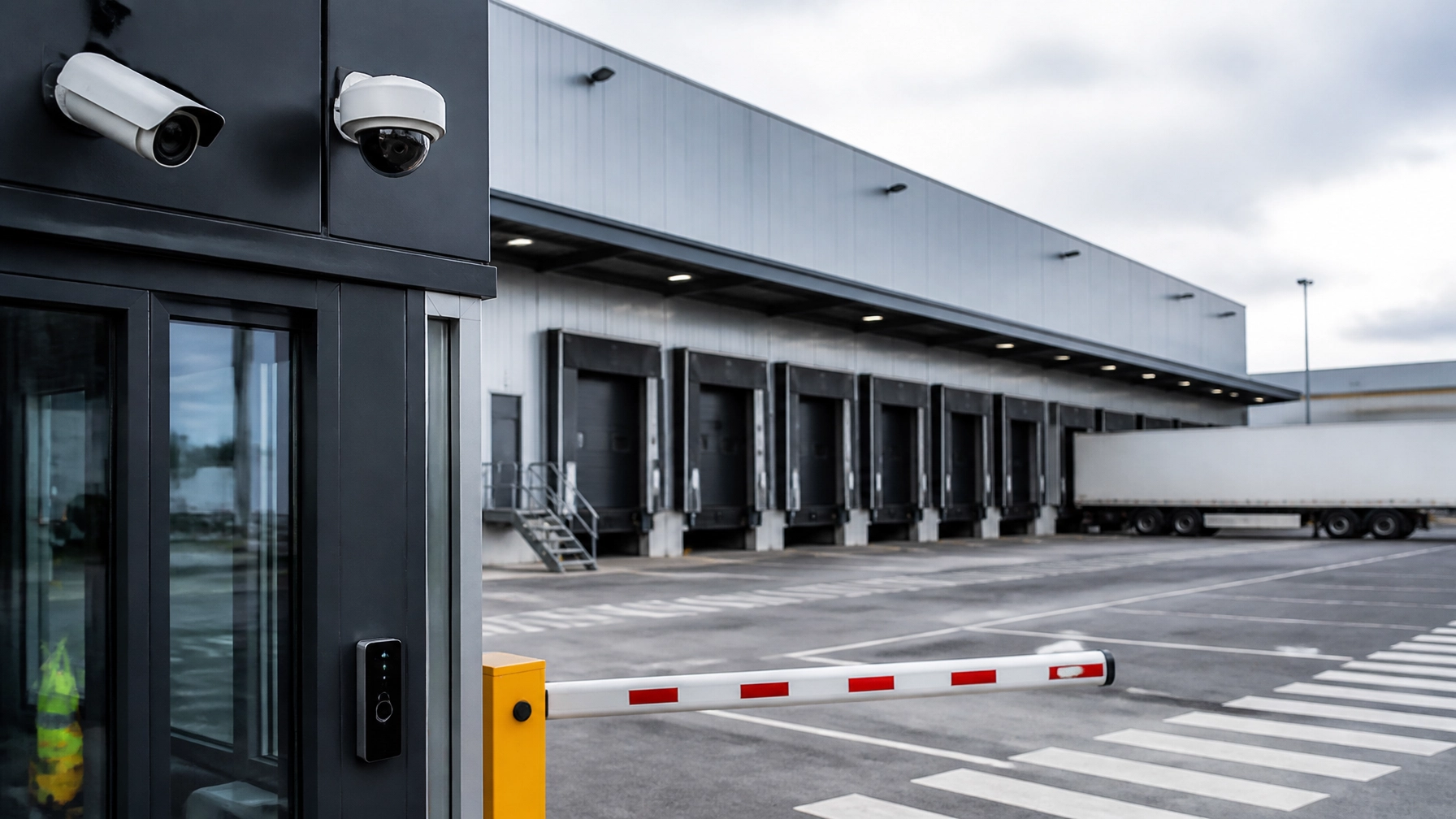
The loading dock is the busiest, most exposed part of a distribution center. People, vehicles, inventory, and vendors move through it constantly, and when controls are inconsistent, that traffic turns into loss, disputes, and compliance headaches.
For IT Directors and Facilities Managers, that’s a real problem. You need visibility, accountability, and uptime you can count on, without adding another person to watch monitors all day. A well-designed dock security program gives you that: less risk, a documented record of activity, and a way to run one site or fifty from the same standard.
At Alen Security, we help you standardize dock security with IP video surveillance, cloud-based access control, and centrally managed systems built to be secure, scalable, and easy to run.
What is loading dock security?
Loading dock security is a layered approach that combines physical barriers, IP video surveillance with analytics, and cloud-based access control. Together, they prevent cargo theft, unauthorized entry, and workflow disruptions at one of the busiest points in your facility.
Why is the loading dock such a common vulnerability?
Because it’s busy by design. Trucks, vendors, employees, and high-value inventory all move through the same area at the same time. That kind of activity hides tailgating, propped doors, blind spots, and unverified access when your systems are outdated or disconnected.
How do video analytics help without adding more manual work?
Video analytics cut down on the need for someone to watch screens all day. The system flags loitering, detects tailgating, and uses License Plate Recognition (LPR) to check vehicles against schedules, so your team only steps in when something actually needs attention.
How do I secure the perimeter around a loading dock?
Perimeter security starts before a truck reaches the bay. The most effective approach combines gates, fencing, lighting, video coverage, and controlled entry, so every vehicle movement is visible and every access event gets documented.
For a lot of facilities, the real gap is inconsistency. A fence and a paper log look like control, but they don’t give you an audit trail, a searchable record of who entered, when, and what happened around it.
We recommend standardizing the perimeter approach across every location. High-resolution IP cameras, gate controls, and scheduled access permissions work together to verify authorized arrivals and flag exceptions: after-hours vehicles, loitering near the fence line, unscheduled deliveries.
Because these systems are centrally managed, your team reviews activity across every site from one place, no separate software, no local workarounds. That cuts vendor sprawl and gives you one operating standard for security, compliance, and investigations.
How does a no-open-ports architecture protect your network?
A no-open-ports approach cuts the unnecessary exposure between your security system and your corporate network. Instead of relying on port forwarding, which can leave avoidable holes in your firewall, secure cloud platforms use encrypted outbound connections. Your systems stay accessible without opening inbound paths into your environment.
For IT teams, that’s the difference between remote visibility and an open door. You get control without loosening your security posture, which is why cloud-based systems can be simple to manage and secure to deploy at the same time.
How do I manage loading dock security across multiple locations?
Multi-site dock security works best when video, access control, alerts, and reporting live on one platform. A centrally managed system gives you one view across locations, one investigation workflow, and one set of standards for your whole team.
That’s what you need when you’re responsible for uptime and accountability but can’t be on site at every facility. Central management lets you respond faster, verify events remotely, and stay consistent as you add locations.
Why does standardization matter in distribution security?
Standardization improves reliability. When the hardware, user permissions, naming conventions, and reporting structure are consistent, your team spends less time figuring out each site and more time solving actual problems.
It also makes regulatory compliance easier. You can document procedures and pull records cleanly during audits, claims, or internal reviews instead of piecing them together after the fact.
Standardization usually includes:
- Uniform hardware: Cameras, readers, and locking hardware built for industrial environments.
- Consistent policies: Role-based access tied to how your sites actually operate.
- Scalable architecture: A platform that adds bays, buildings, or sites without a rebuild.
What are the most common loading dock security vulnerabilities?
Most loading dock losses trace back to a handful of recurring issues. It’s rarely a lack of activity. It’s a lack of visibility, access discipline, and documentation around that activity.
Here are five issues we see repeatedly in distribution environments.
How do I prevent unauthorized tailgating?
Tailgating happens when a second vehicle or person follows an authorized entry without its own verification. Video analytics and controlled gate logic catch that pattern and send an alert so your team can review it fast.
Every entry ties back to a credential, a vehicle record, or a verified schedule, not a guess. That’s what accountability actually looks like.
How do I address propped doors and door-held-open events?
Dock doors get propped open for convenience during busy shifts more often than anyone wants to admit. Door position monitoring flags doors that stay open past an approved threshold and sends an automated notification with the related video.
Supervisors catch it before it turns into a loss or a safety issue, without walking the floor to check every door themselves.
How do I investigate internal shrinkage or collusion?
Some losses come from process failures or collusion, not forced entry. Searchable video tied to shipment timing, pallet activity, or related transactions gives you the context to investigate exceptions properly.
An integrated record makes claims review and internal investigations faster, and easier to defend when someone asks how you know.
How do I manage vendor access at the dock?
Vendor access should be temporary, specific, and documented, full stop. Cloud-based access control lets you issue scheduled credentials that expire automatically, so vendors get into only the areas and times you approve.
No more tracking physical keys. You get a clear record of who was on site and when.
How do I eliminate blind spots and poor image quality?
Loading docks create tough lighting, bright sun outside, dim bays inside. Cameras with Wide Dynamic Range (WDR) handle both extremes in the same scene, so you keep usable detail at doors, bays, and vehicle approaches instead of blown-out highlights and black shadows.
Placement, lighting, and lens selection matter as much as resolution. Good design is what turns footage into evidence you can actually use in a claim or investigation.
How can analytics support operations as well as security?
Analytics support business decisions too, not just security ones. Dwell time reports show carrier delays. Vehicle counts verify throughput. Safety-related events flag patterns around restricted zones or forklift traffic.
That’s real business intelligence without bolting on a separate system, and it puts operations, facilities, and security on the same data instead of three different spreadsheets.
How does loading dock security support compliance and accountability?
A good dock security system builds a reliable record of access events, alarms, and related video. That record backs up compliance, investigations, and internal reporting, because you can show what happened instead of relying on a handwritten log or someone’s memory.
For distribution centers managing standards like C-TPAT or OSHA documentation, that’s not optional. You need records that are consistent, searchable, and retained long enough to support audits, claims, and incident review.
IDENTIFY. DOCUMENT. VERIFY. RETAIN.
Integrated systems keep a digital audit trail, a time-stamped history tied to doors, credentials, alarms, and video. When an auditor, insurer, or operations leader asks for documentation, your team pulls it in minutes, not days.
How does fire and life safety fit into dock security?
Loading docks combine heavy equipment, vehicle traffic, packaging materials, and electrical devices. Fire and life safety needs to be planned alongside security, not bolted on after.
When fire alarm systems and door hardware are coordinated correctly, doors respond the right way during an emergency, and video still gives you situational awareness. That means safer egress and better information for first responders when it counts.
What does a loading dock security partner actually deliver?
You need more than equipment. You need a system that’s designed right, installed cleanly, documented clearly, and supported over time, not just at the ribbon cutting.
That’s where experience shows. With more than 50 years in commercial security, we help you simplify decisions, standardize systems, and hold the line on quality from design through service.
CONSULT. DESIGN. INSTALL. MAINTAIN.
- CONSULT: We review your dock layout, workflows, risks, and compliance needs.
- DESIGN: We build a practical solution using reliable, open, scalable technology.
- INSTALL: Our team deploys the system with an eye on uptime, safety, and consistency.
- MAINTAIN: We provide ongoing service so the system stays dependable as your needs change.
Can I improve loading dock security without replacing everything?
Yes. In most cases, you can modernize in phases. If your existing cameras, door hardware, or network infrastructure still perform, we can integrate them into a newer platform instead of ripping everything out at once.
That means fewer disruptions to your operation now, and an easier expansion later, because you’re building toward one clean, scalable standard instead of patching around old ones.
Why do locksmith services still matter at a loading dock?
Physical hardware still matters. A cloud reader or camera can’t make up for a weak strike, a worn closer, or a door that doesn’t latch every time.
Commercial locksmith expertise makes sure doors, cylinders, electrified hardware, and related components are built for industrial use and work with your electronic system, not against it. That’s what separates a solution that’s actually quality driven from one that just looks good on paper.
Why work with Alen Security on loading dock security?
We build long-term relationships by making security easier to manage and easier to trust. That means clear recommendations, standardized systems, secure architectures, and support that doesn’t disappear after installation.
For facilities and IT teams, the benefit is practical. One partner handles consultation, design, installation, service, and accountability going forward. That’s less complexity for you as your organization grows, not more.
Key Takeaways
- Loading dock security works best layered: video, access control, physical hardware, lighting, and documented workflows working together, not as separate systems.
- Centralized management means one platform, one investigation workflow, and one standard across every site, so you’re not managing five sets of tools to cover five locations.
- A no-open-ports architecture keeps your network protected without giving up remote visibility and control.
Frequently Asked Questions
How do I prevent truck drivers from accessing the warehouse interior?
Put in a driver cage or a dedicated vestibule with cloud-based access control. Drivers check in at the dock without ever reaching the main floor, and cameras with two-way audio let your team talk to them without face-to-face contact.
Can I manage security for multiple warehouses from one mobile app?
Yes. Our centrally managed cloud platforms let you view live video, review access logs, and lock or unlock doors across every location, right from your phone.
What is License Plate Recognition, and do I need it?
License Plate Recognition, or LPR, uses specialized cameras to read and log truck plates automatically. On a busy dock, it speeds up check-in and gives you a searchable record of every vehicle that’s been on site.
How does “No Open Ports” technology protect my corporate network?
Older systems often rely on port forwarding, which can leave holes in your firewall. Our cloud-based approach uses secure outbound-only connections, so your security system stays connected without exposing your internal network.
How long should I keep loading dock video footage?
For logistics and distribution sites, 30 to 90 days is a practical baseline. That window usually covers the period when shipment discrepancies, claims, or investigations actually surface.
Can security systems help reduce workers’ compensation claims?
Yes. Video analytics capture near-miss incidents and verify safety protocol compliance, which gives you real documentation for training, investigations, and reducing liability.
Is cloud-based access control more expensive than traditional systems?
Not necessarily. Upfront hardware costs are usually similar, but cloud systems tend to cost less long term since you’re not maintaining local servers, pushing manual updates, or adding extra IT overhead.
What happens if the internet goes down?
Your system keeps working locally. Cameras keep recording, and access control readers still function off the most recently synced permissions. Once connectivity comes back, everything syncs back to the cloud.
Do I need to replace all my current cameras to get AI analytics?
Not always. In a lot of cases, AI-enabled bridges or recorders can add analytics to your existing IP cameras, and even some analog systems.
Why choose a security integrator instead of a guard service?
A guard can only watch one area at a time. An integrated system covers multiple points 24/7, sends automated alerts, and builds a stronger audit trail, usually at a lower long-term cost.
What should you do next if your loading dock security is inconsistent?
If your dock security is fragmented, outdated, or hard to manage, the next step is a straightforward assessment. We’ll help you identify the gaps, standardize your approach, and build a system that supports compliance, uptime, and accountability, without adding complexity you don’t need.